Currently our inference re-uses Roslyn's flow-analysis.
However, this has some fundamental problems.
9:	Dictionary<T, Node> mapping = new Dictionary<T, Node>();

11:	Node? GetNode(T element)
	{
13:		Node? node;
14:		if (!mapping.TryGetValue(element, out node))
15:		{
16:			node = new Node();
17:			mapping.Add(element, node);
18:		}
19:		return node;
	}
There's no edges created for line 16/17 because here Roslyn knows that node is non-null.
Line 14 creates two edges: one from <nullable> because TryGetValue will assign null when returning false; the other from mapping!1#2 (the mapping field's Node type argument) when TryGetValue returns true.
The return statement creates an edge from the variable's type, because Roslyn's flow analysis can't guarantee us that the variable is non-null -- our Roslyn code analysis runs under the pessimistic assumption that all types-to-be-inferred might end up nullable, so it considers mapping to be Dictionary<T, Node?>, which leaves open the possibility that GetNode returns null.
However, after our inference decides that mapping!1#2 is non-null, it would be correct to also indicate that the GetNode return value is non-null. After all, if no node exists yet, the function will create one.
The issue here is that Roslyn's flow analysis isn't aware of our types-to-be-inferred.
It would be better if, instead of using Roslyn's flow analysis, we had our own that keeps track of node's nullability.
The idea would be to create additional "helper" graph nodes for the different flow states of a local variable of reference type.
After TryGetValue initializes node, it's flow-state would be (true: mapping!1#2, false: <nullable>). Within the if body, the flow-state would initially be <nullable>, but after line 16 would change to <nonnull>.
After the if, the flow-state from both alternatives could be re-combined by creating a new node "node-after-line-18" and edges from the nodes from the two if-branches -- in this case <nonnull> from the then-branch and mapping!1#2 from the else branch.
Then the return statement would create an edge from this "node-after-line-18" instead of the node for the variable's declared type.
All flow-state nodes associated with a variable would have an edge to the variable's declared type node.
We'd end up with a graph somewhat like this:
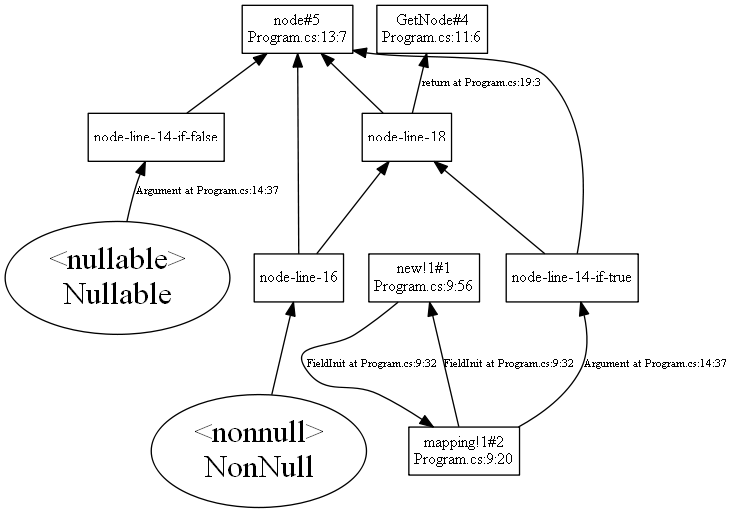
Thus in the end, node would be inferred as nullable, but the GetNode return type would only depend on mapping!1#2 and thus can be inferred depending on whether there's a mapping.Add(x, null) access somewhere else in the program.

Currently our inference re-uses Roslyn's flow-analysis.
However, this has some fundamental problems.
There's no edges created for line 16/17 because here Roslyn knows that
nodeis non-null.Line 14 creates two edges: one from
<nullable>becauseTryGetValuewill assignnullwhen returningfalse; the other frommapping!1#2(the mapping field'sNodetype argument) whenTryGetValuereturns true.The
returnstatement creates an edge from the variable's type, because Roslyn's flow analysis can't guarantee us that the variable is non-null -- our Roslyn code analysis runs under the pessimistic assumption that all types-to-be-inferred might end up nullable, so it considersmappingto beDictionary<T, Node?>, which leaves open the possibility thatGetNodereturns null.However, after our inference decides that
mapping!1#2is non-null, it would be correct to also indicate that theGetNodereturn value is non-null. After all, if no node exists yet, the function will create one.The issue here is that Roslyn's flow analysis isn't aware of our types-to-be-inferred.
It would be better if, instead of using Roslyn's flow analysis, we had our own that keeps track of
node's nullability.The idea would be to create additional "helper" graph nodes for the different flow states of a local variable of reference type.

After
TryGetValueinitializesnode, it's flow-state would be (true:mapping!1#2, false:<nullable>). Within theifbody, the flow-state would initially be<nullable>, but after line 16 would change to<nonnull>.After the if, the flow-state from both alternatives could be re-combined by creating a new node "node-after-line-18" and edges from the nodes from the two if-branches -- in this case
<nonnull>from the then-branch andmapping!1#2from the else branch.Then the
returnstatement would create an edge from this "node-after-line-18" instead of the node for the variable's declared type.All flow-state nodes associated with a variable would have an edge to the variable's declared type node.
We'd end up with a graph somewhat like this:
Thus in the end,
nodewould be inferred as nullable, but theGetNodereturn type would only depend onmapping!1#2and thus can be inferred depending on whether there's amapping.Add(x, null)access somewhere else in the program.